Military Diplomacy and Pakistan’s Foreign Policy
Synopsis
The op-ed demonstrates that Pakistan achieved its first diplomatic achievement through its mediation of the US-Iran ceasefire on April 8, 2026, because Field Marshal Asim Munir used his personal connection to President Trump to advance Pakistan’s military interests instead of utilizing diplomatic channels that Pakistan’s foreign policy experts had established. It warns against treating this as a replicable template and calls for the urgent institutionalization of Pakistan’s diplomatic gains within civilian structures.
Op-Ed
On the evening of April 8, 2026, with Donald Trump’s self-proclaimed deadline to end “Iranian civilization” ticking down to its final ninety minutes, it was not Pakistan’s Foreign Minister who picked up the phone. Field Marshal Asim Munir, directly to the President of the United States, placed the call that mattered— the one that gave a world on edge permission to breathe again. Hours later,
Trump announced a two-week ceasefire with Iran, explicitly crediting “conversations with Prime Minister Shehbaz Sharif and Field Marshal Asim Munir, of Pakistan.” Pakistan had just pulled off what analysts are already calling the most consequential act of diplomacy in its history. The question worth asking is: why was it the army chief who did it?
The division of labour in Pakistan’s Iran mediation was revealing. Prime Minister Shehbaz Sharif engaged Iranian President Masoud Pezeshkian and made the public announcements. However, it was Munir who maintained the direct backchannel to Trump, coordinated with senior US officials, including JD Vance and Steve Witkoff, and kept lines open to figures within Iran’s Islamic Revolutionary Guard Corps. According to foreign affairs journalist Baqir Sajjad Syed,
the entire negotiation was conducted through encrypted messaging apps — WhatsApp with the Iranians and Signal with the Americans — with embassies kept deliberately at arm’s length. The civilian government provided the diplomatic cover; the military provided the actual advantage. This is not a criticism of the outcome.
But the architecture of that achievement reveals a structural reality that Pakistan has long avoided examining: its foreign policy, at its most consequential moments, is run from Rawalpindi, not Islamabad.
The Munir-Trump relationship did not emerge overnight. It was built through deliberate, transactional engagement. The arrest of the Abbey Gate bomber first caught Washington’s attention. The 2025 India-Pakistan conflict cemented it — Trump publicly credited Munir with helping defuse that crisis and subsequently made history by hosting a Pakistani army chief for a White House lunch without a head of state present.
It was in that meeting that Trump reportedly hinted Pakistan “knows Iran better than most.” The stage for April 2026 was set over a year earlier, through a personal rapport between a field marshal and a president that bypassed every formal diplomatic channel.
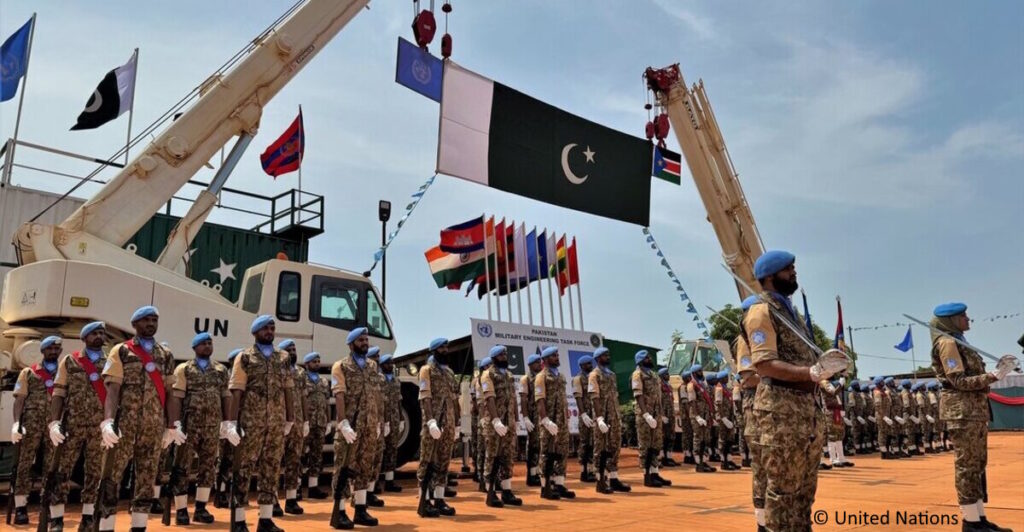
What is new under Munir is the degree to which the military’s foreign policy role has been formalized. The 27th Constitutional Amendment created the position of Chief of Defence Forces — a role Munir now holds alongside the army chief, consolidating command over all three services and granting him a tenure extended through 2030.
Analysts have noted that this concentration of authority gives Munir “wide latitude to take strategic risks, with few institutional checks on his decisions”. In foreign policy terms, this means Pakistan now has a single powerful individual who can make credible commitments to foreign leaders without parliamentary approval, cabinet sign-off, or opposition buy-in. For crisis diplomacy, this is an asset. For democratic governance, it is a warning sign.
The ceasefire’s success will tempt Pakistan into treating the Munir model as the template for future diplomacy. That would be a mistake. Personalized military diplomacy is inherently fragile. It depends on the longevity of the individual, the continuation of a particular foreign leader’s goodwill, and the absence of a domestic crisis that forces the military’s attention inward. Trump will not always be president. Munir will not always be the army chief.
And the crises that demand mediation — Iran, India, Afghanistan — will not pause for Pakistan’s internal transitions. A foreign policy architecture built on one man’s phone book is not a foreign policy; it is a gamble dressed as strategy.
Pakistan must now do something harder than celebrating. It must institutionalize the gains. The relationships built by Munir with the Trump administration, with Gulf states, with Iranian interlocutors — these need to be transferred into civilian foreign policy architecture. The Foreign Office needs the resources, the personnel, and — critically — the authority to manage these channels independently of GHQ.
The National Security Committee needs to function as a genuine civilian-military coordination body, not a rubber stamp for decisions already taken in Rawalpindi. And Pakistan’s parliament, long excluded from meaningful foreign policy debate, needs to be brought in. Sustainable diplomacy requires institutional legitimacy, not just individual brilliance.
Pakistan stood at the center of the world on April 8, 2026. South Asia expert Michael Kugelman called it “one of Pakistan’s biggest diplomatic wins in years” — a verdict echoed from Bloomberg to The Diplomat to Al Jazeera. The country earned that moment through years of quiet relationship-building, geographic positioning, and Munir’s particular genius for reading the room. However, the world’s attention is a perishable commodity.
The question is not whether Pakistan can broker a ceasefire. It has now proven that it can. The question is whether Pakistan can build a foreign policy establishment worthy of the role it has claimed — one that survives the next election, the next army chief, and the next crisis without needing a field marshal to pick up the phone.
Sources / Hyperlinks Used
- CNBC — Trump-Iran ceasefire announcement
- Al Jazeera — How Pakistan managed the ceasefire
- Al Jazeera — JD Vance and Pakistan’s mediation
- TRT World — Backchannel via WhatsApp/Signal
- The Diplomat — Pakistan’s military global stature
- The Diplomat — Pakistan as Peacemaker
- Wikipedia — Asim Munir / 27th Amendment
- Modern Diplomacy — Munir’s institutional powers
- Al Jazeera — Munir as Trump’s favorite field marshal
- TRT World — World reaction to ceasefire
- Visual Pakistan — Institutionalizing diplomatic gains
- Bloomberg — Pakistan’s central role in global politics
- France 24 — How Pakistan brokered the ceasefire

Ms. Munaza Zainab
Munaza Zainab is lead operations supervisor at Indus Strategic Institute - ISI and Strategic Studies student