Write by: Aleena Saif Ullah
Insurance, Not Warships: The Strategic Lesson China Drew from Operation Epic Fury
Aleena Saif Ullah The writer is an MPhil Scholar in International Relations, specializing in global defence and security, University of the Punjab, Lahore.
In 1991, the Gulf War transformed Chinese military planning. The People’s Liberation Army watched American precision weapons destroy Iraqi armored formations in days, absorbing a lesson about the capability gap that it spent the next thirty-five years closing. The 2003 Iraq War reinforced the lesson: the PLA’s response was not to match U.S. capability symmetrically but to develop anti-access and area denial architectures specifically designed to prevent U.S. power projection in its near abroad. Operation Epic Fury is producing the same institutional response — a systematic processing of operational lessons from a conflict Beijing did not participate in — but with a different and more uncomfortable set of findings. As Admiral Samuel Paparo, head of U.S. Indo-Pacific Command, confirmed in congressional testimony this week, China’s military has been monitoring U.S. and Israeli operations against Tehran, “learning from the successful use of advanced military decision-making power.” What it is finding, according to the Centre for International Maritime Security’s analysis, goes well beyond the tactical lessons that have dominated media coverage.
The tactical lessons are significant but broadly familiar. AI-enabled targeting at machine speed, the cost-exchange problem with interceptors, the vulnerability of single high-value platforms to saturation attack, the mosaic defense doctrine’s resilience under decapitation pressure — these confirm what the PLA’s planning documents have long assumed about the trajectory of U.S. military capability. The deeper lessons are maritime, and they are less comfortable for Beijing than for Washington. The Hormuz crisis demonstrated, at operational scale and in real time, that China’s own strategic vulnerability is not primarily naval. It is commercial and financial.
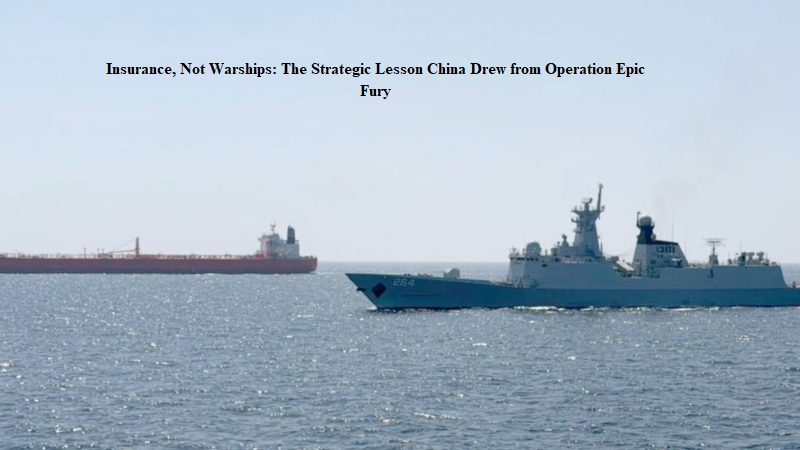
Within seventy-two hours of Epic Fury’s launch, the International Group of P&I Clubs — which collectively insure approximately ninety percent of ocean-going tonnage — began issuing cancellation notices for Gulf war-risk coverage. Traffic through the Strait of Hormuz fell by approximately 95 percent. Not because of mines, though mines were eventually laid. Not because of naval interdiction, though Iranian fast boats harassed shipping. Because underwriters calculated that the actuarial risk exceeded viable premium levels, and when P&I coverage is cancelled, ships cannot sail regardless of what navies say about corridor safety. China, which depends on the Strait of Hormuz for over forty percent of its crude oil imports, could not compel those underwriters to write policies. The world’s second-largest economy, with the world’s largest navy by vessel count, was reduced to publicly urging “all parties to keep shipping routes in the Strait of Hormuz safe” and opening direct talks with Iran to negotiate safe passage for Chinese energy shipments. As CIMSEC’s analysis observed: “A nation that must ask permission to use a chokepoint does not command it.”
For PLA planners gaming a Taiwan contingency, this lesson maps directly and uncomfortably. Beijing has spent decades building the naval force it would need to establish sea control in a cross-strait scenario. The Hormuz crisis suggests the decisive question in a Taiwan contingency may not be naval at all. It may be whether the Strait of Malacca — through which approximately 80 percent of China’s energy imports pass — remains open under a wartime insurance regime managed by Western financial institutions. The same mechanism that closed Hormuz in seventy-two hours could close Malacca in the same timeframe. No PLAN destroyer can compel an underwriter at Lloyd’s of London to write a policy. China’s vulnerability is not that it lacks naval capability. It is that its commercial economy depends on sea lanes whose financial infrastructure is controlled by institutions in jurisdictions that would be adversaries in any Taiwan contingency.
China is responding to this vulnerability with characteristic strategic deliberateness. It has been building state-backed maritime insurance mechanisms and positioning its commercial fleet to operate under sovereign-risk coverage. The 2026 Beijing military parade — showcasing autonomous drone swarms, confirming accelerated submarine construction that Paparo enumerated as twelve submarines delivered since 2024 including nuclear attack and ballistic missile variants, an aircraft carrier, two cruisers, and ten destroyers — reflects the technological acceleration that Epic Fury’s operational data has validated. But the more consequential adaptation is financial and commercial: China is attempting to insulate its strategic economy from the Western-backed financial architecture that proved, in 2026, capable of imposing a maritime blockade that naval force alone could not replicate.
The Taiwan deterrence implications are specific and documented. Paparo confirmed that THAAD systems were moved from South Korea to support Midnight Hammer operations and have not all returned. The U.S. intelligence community’s 2026 Annual Threat Assessment judged that Chinese leaders “do not currently plan to execute an invasion of Taiwan in 2027” but are “probably seeking to set the conditions for eventual unification short of conflict.” The Hormuz crisis has demonstrated to Beijing both the capabilities and the vulnerabilities of a sustained U.S. power projection campaign — not in isolation, as theoretical analysis would provide, but in the specific conditions of actual combat, against actual defenses, with actual depletion rates for actual weapons systems. Desert Storm prompted thirty-five years of PLA investment in closing the capability gap. Operation Epic Fury will prompt a different kind of investment — in maritime financial resilience, in autonomous undersea warfare, in the ability to sustain a commercial economy under wartime insurance conditions — because the lesson Beijing has absorbed is not that American power is overwhelming but that American power has specific structural dependencies that chokepoint control and financial architecture can exploit.

Aleena Saif Ullah
The writer is an MPhil Scholar in International Relations, specializing in global defence and security, University of the Punjab, Lahore.