Write by: Aleena Saif Ullah
The Algorithm Also Learned: How AI Switched Sides in the First AI War
The first AI war produced an assumption nobody questioned: AI was America’s weapon. The conflict’s most consequential intelligence development suggests otherwise.
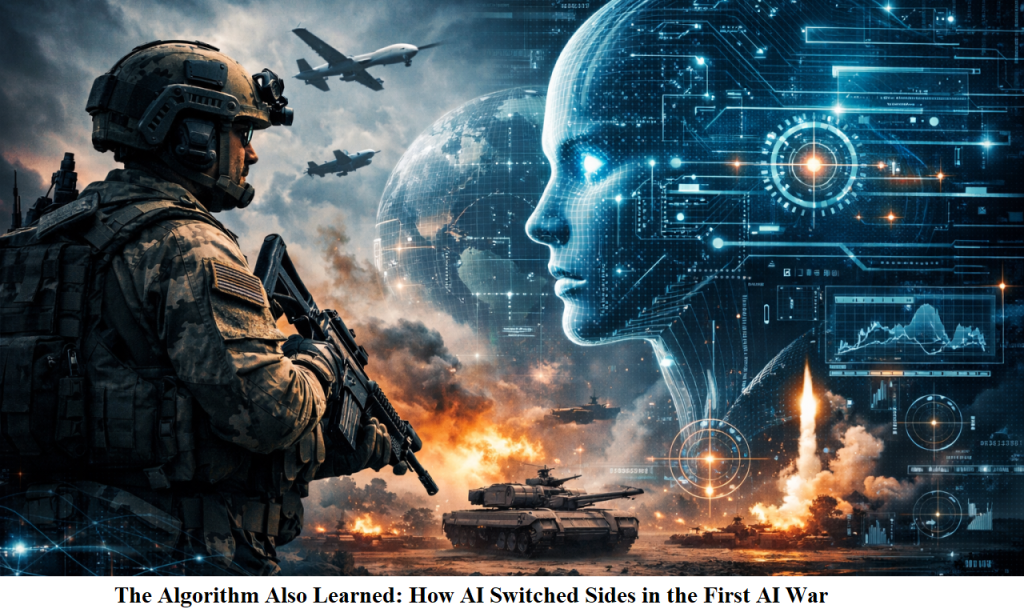
Every analysis of Operation Epic Fury has concentrated on what AI did for the United States — the Maven Smart System processing intelligence at machine speed, 5,500 strikes in eleven days, the compression of the sensor-to-shooter cycle to near real time. That account is accurate. It is also incomplete. The AI that shaped this conflict did not flow in one direction only. While Washington was using machine learning to find targets faster than humans could authorize them, adversaries were using commercially available AI to find the humans operating those machines. The first AI war did not produce an AI monopoly. It produced an AI arms race — and the asymmetric actors in that race have moved faster than the doctrine governing the systems they are targeting.
The evidence is specific and documented. According to U.S. defense intelligence cited by ABC News on April 5, 2026, Iranian forces used AI-enhanced satellite imagery from Chinese firm MizarVision to refine targeting of U.S. military installations across the Middle East. The system uses automated object recognition and tagging, allowing operators to identify bases, equipment, and infrastructure in minutes rather than hours. Simultaneously, Chinese firm Jing’an Technology — whose “Jingqi” platform blends data aggregation with inference — claimed to have tracked four B-2A Spirit stealth bombers during U.S. strikes on Iranian targets, reconstructing their flight paths and intercepting publicly available aviation channel communications. A March 2026 Kharon research brief noted that while some of Jing’an’s claims may be overstated, the methodology is real: AI-driven open-source intelligence combining flight tracking data, signals intercepts from public channels, and historical operational patterns to reconstruct classified movements from unclassified data points. The B-2 is the most sophisticated stealth bomber in the American arsenal. Its flight paths were being reconstructed in near real time by a commercial platform available to any state actor willing to pay for access.
This is the inversion that existing AI warfare analysis has not adequately processed. The dominant framework assumes that AI advantages flow from technical sophistication to technical sophistication — that the state with the most advanced AI targeting architecture has the decisive edge. What the Iran conflict has demonstrated is that AI-enabled open-source intelligence requires no classified access, no state-level investment, and no technical parity with the adversary. It requires only the ability to aggregate publicly available data faster than the adversary assumes possible. ADS-B flight tracking data is public. Social media posts from military bases are public. Commercial satellite imagery is commercially available. The AI that turns those individually innocuous data streams into a targeting intelligence product is increasingly accessible to any actor with the resources to license it. The asymmetry that precision standoff warfare was supposed to create — the safe operator, the remote strike, the distance between the human and the threat — is being eroded not by matching U.S. capabilities but by redirecting commercial AI tools against the humans operating them.
The Houthi drone trajectory illustrates the same dynamic at the tactical level. Analysis by the Orion Policy Institute documents the trajectory of Houthi drone capability toward AI-enabled image-based navigation — a guidance methodology that renders GPS jamming, the primary Western counter-drone tool, effectively obsolete. A drone navigating by terrain recognition rather than GPS signal cannot be deflected by electronic warfare. It must be physically intercepted or destroyed before launch. The cost asymmetry this creates is structurally significant: the United States is deploying multi-million dollar surface-to-air missiles to intercept drones that cost tens of thousands of dollars and navigate by machine learning. The U.S. military recognised this asymmetry and responded with Task Force Scorpion Strike — deploying LUCAS drones reverse-engineered from the Iranian Shahed-136, with swarming features and adaptive targeting, at $35,000 per unit. The adaptation confirms the threat it is responding to. When the world’s most powerful military begins reverse-engineering its adversary’s drones, the direction of technological influence has shifted in ways that force posture planning had not anticipated.
The strategic implication extends beyond this conflict. The first AI war has established that AI-enabled targeting is not a capability gap that only advanced militaries can exploit. It is a methodology that commercially available tools, state-sponsored platforms, and adversarial intelligence agencies can deploy against the operators of precision strike systems using entirely open-source data. Every future precision strike campaign will be conducted in an environment where the adversary is simultaneously attempting to locate, identify, and target the human operators of those systems using the same class of AI tools the operators are using against them. The doctrine of standoff warfare assumed that distance protected the operator. AI-enabled OSINT has collapsed that distance — not through technical parity but through the redirection of commercial intelligence tools against a target set that standoff warfare doctrine never considered: the people behind the screen.
The arms control architecture that governs this environment does not exist. There are no agreements limiting the military use of commercial AI platforms. There are no norms governing the weaponisation of open-source data against military personnel. There are no verification mechanisms that could distinguish a commercial satellite imagery subscription from a targeting intelligence programme. The first AI war has demonstrated that these gaps are not theoretical. They are operational — and the next conflict will begin with both sides already using them.

Aleena Saif Ullah
The writer is an MPhil Scholar in International Relations, specializing in global defence and security, University of the Punjab, Lahore.